






Service / SEO for Therapists
Private & group practices · Local SEO + AEO

SEO for therapists who want to be found by the right clients.

Someone is searching for help right now, in words that describe exactly what you do. I help therapy practices show up for those searches: a clear niche, a page for every specialty, and the trust signals Google expects from a mental health site.

How people actually search
  1. General search1,600/mo · KD 69/100
    therapist nyc
  2. Modality + city100/mo · KD 0/100
    jungian analyst nyc
  3. Who it is for100/mo · KD 0/100
    therapy for creatives

Monthly searches and keyword difficulty, Ahrefs US data, October 2026.

Therapy practices I work with

Shifting Tides Therapy logoBrooklyn North Creative Arts Therapy logoBrooklyn Therapies logoRachel Parodneck & Associates Psychotherapy logoSamantha Waldman Therapy Services logoFSJ Psychotherapy logoWell with Risha logo
§ 01 · Proof · Case 004

A virtual therapy practice, from about one organic visit a month to 500+ clicks from Google.

Seven months of SEO for a three-clinician practice licensed in New York, Connecticut and Florida. We stopped competing for the city and built pages for the exact situations people search for.

Read the full case study
Website inquiries · August, year on year
3.5×

Fourteen people reached out through the website in August 2026. The August before: four.

Search visibility, week by week, across the engagement.

Search impressions a week · Google Search Console
5K10K15K20KAUG 10-16 · 19.3K IMPRESSIONSMAR 30 · FIRST FULL WEEK · 4.4K
Apr 2026May 2026Jun 2026Jul 2026Aug 2026
~1 → 546Estimated organic visits a month
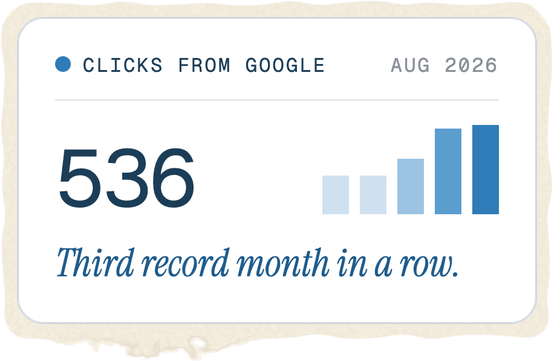
234 → 536Clicks from Google a month, April to August
13 → 69Keywords in the top 20
#1“Endometriosis support group”, within weeks

Search Console was installed in February 2026, so the chart runs from the first full Monday-to-Sunday week of data (March 30) to the week of August 10 to 16, 2026. Organic visits are Ahrefs estimates, August 2025 to July 2026. Keywords are US positions 1-20, April to July 2026.

The argument
SEO is not self-promotion. It is being findable.

Most therapists I meet are uneasy about marketing, and most therapy websites show it: a name, a license, a warm paragraph, and no way for a stranger to find any of it. The practice is real. The search visibility is zero.

Therapist SEO is not about shouting louder than the directories. It is about making it easy for the right person to find you, by matching the words they type to the work you do best.

I work as a fractional SEO consultant, not an agency reselling a checklist. Most of my clients are therapy practices, so the audit, the strategy and the pages come from someone who knows how your clients search and how your field talks.

A therapy office seen through a half-open black door: pale blue moire walls, a slate-blue velvet settee, a walnut armchair and pink sweet peas on a small round table.
Plate IThe room is ready. Search is how they find the door.
§ 02What a first audit usually finds

Every engagement starts with an audit, and therapy sites tend to have the same six gaps. None of them needs a developer to fix.

  1. 01Titles

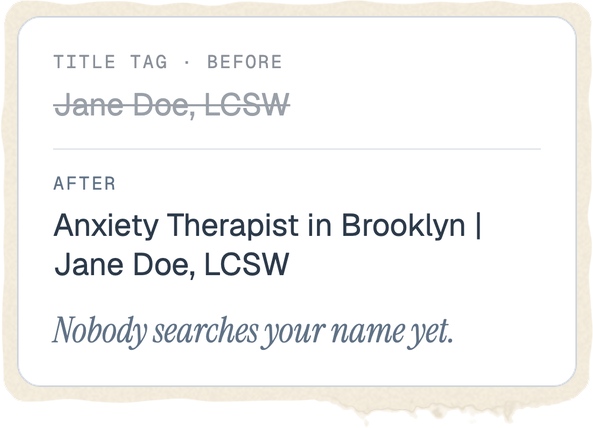
    The site ranks for your name, and nothing else.

    The homepage title is your name and your license. That works for referrals who already know you. Nobody searching for help knows your name yet.

    The fixLead every title with what you treat and where. Your name goes last.
  2. 02Structure

    Every specialty lives on one list page.

    Anxiety, grief, couples work and EMDR share a single URL, so none of them can rank. Google matches a search to a page, not to a bullet point.

    The fixOne page per specialty, each built around a single search term.
  3. 03Keywords

    The effort goes into the hardest terms.

    "Therapist" plus your city is crowded with directories. The specialties you are known for often sit wide open, with real demand and little competition.

    The fixChoose three to five niche terms you can win, and build out from there.
  4. 04Trust

    Your credentials are missing where Google looks.

    Mental health is a topic Google holds to a higher standard. License, training and years in practice are often on the about page only.

    The fixCredentials on every service page, an author on every article, practice and person schema.
  5. 05Location

    The geography is muddled.

    The title says one neighborhood, the pages say three others, and the states you are licensed in never appear in the text.

    The fixOne set of service areas, repeated in titles, headings and schema.
  6. 06Blog

    The blog is an island.

    Thoughtful posts that answer no question people search, and link to no service page. The voice is right. The posts have nowhere to lead.

    The fixAnchor each post to a real question and link it to the page it supports.
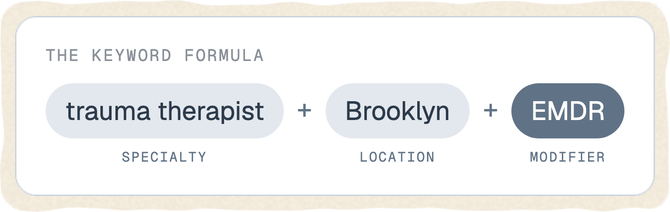
§ 03 · Niche positioning

You do not need to win the city. You need to own your corner of it.

01 · Specialty
What you treat best

Trauma, couples work, perinatal anxiety, eating disorders. The thing colleagues refer to you for is usually the term with the least competition.

02 · Location
Where you can see clients

The neighborhood of your office, the city, and every state you are licensed in. Virtual practices rank by state, not by street.

03 · Modifier
Who it is for, or how

EMDR, virtual, for lawyers, for new mothers. This is where “therapy for high achievers” turns out to be searched as “founder therapy”.

Three to five terms like these become the focus of the whole site. The monthly data shows which ones to double down on.

§ 04The work, piece by piece

A technical audit first, then the niche, then pages. This is what an engagement covers.

01Technical audit & foundations

One clear heading per page, a title and description written for the search result, clean URLs with redirects, and working indexing. These are the first things Google reads, and most website builders hide them in settings.

02Niche & keyword map

A researched list of the terms your practice can realistically win, each assigned to one page. Therapist keyword research that separates the service pages worth building now from the long-game topics to leave for later.

03Specialty & modality pages

A dedicated page for each thing you treat and each way you work: anxiety, grief, couples, EMDR, IFS, psychodynamic therapy. Written in your voice, built around one keyword, and ending in a clear way to book a consultation.

04Credentials, schema & local presence

License, training and author attribution on every page and article, plus practice, person and FAQ schema. For in-person and “near me” searches, a complete Google Business Profile and a contact page with address, hours and map.

05Blogging without burnout

You bring the insight, I bring the brief: the question people are asking, the keywords to work in, and the tables or lists the top results use. Every article links to the specialty page it supports, so the blog feeds the practice.

06Monthly reviews & next steps

A short review each month from Google Search Console and Ahrefs: what moved, which long-tail terms appeared, and what to optimize next. Done-for-you or done-with-you, depending on how hands-on you want to be.

§ 05 · A realistic timeline

A slow burn, not a quick fix. Nothing you publish disappears.

  1. 1-3Months · Foundation

    Technical fixes and core pages go in. Google rediscovers the site; a new or updated page takes two to three weeks to register.

  2. 3-6Months · Early signs

    Rankings start to appear for the niche terms, and the first non-branded clicks arrive.

  3. 6+Months · Momentum

    Content compounds. Each new page builds on the authority of the ones before it.

An aside

The people you help best are already searching. Let’s see what stands between them and your site. Start with a $50 therapist SEO audit→

§ 06Questions, answered

What is SEO for therapists?

SEO for therapists is the work of making a practice's website show up when someone searches for the kind of help that practice offers: a clear niche, a dedicated page for each specialty, visible credentials, and a technical base Google can read. The goal is not more traffic for its own sake. It is more inquiries from clients who are a good fit.

How long does SEO take for a therapy practice?

Plan for three to six months. In months one to three the technical fixes and core pages go in and Google rediscovers the site; a new or updated page usually takes two to three weeks to register. Rankings start to appear between months three and six, and from month six the content compounds, because each new page builds on the authority of the last.

Can a solo practice rank for "therapist near me"?

Rarely, and it is usually the wrong fight. Broad terms like "therapist NYC" are held by directories and large group practices. A solo or small practice wins on the combination of specialty, location and modifier, for example "psychodynamic therapy NYC" or "EMDR therapist Brooklyn". Those searches are smaller, far easier to rank for, and the people behind them already know what they need.

Do I have to blog?

No, but it helps, and it does not have to be a treadmill. One to three pieces a month is enough to build momentum. You write about what you want to write about; I bring the briefs, the keywords and the questions people are asking, so your expertise meets an actual search. If you would rather not write at all, I draft and you review for clinical accuracy and voice.

Does SEO work for telehealth and multi-state practices?

Yes. Telehealth works best as a modifier on each service page ("online EMDR therapy in New York") instead of a standalone page, and every state you are licensed in should be named in the copy and in the schema. Practices licensed in several states often get a dedicated page per state.

Will ChatGPT and Google's AI answers recommend my practice?

They can only cite what they can find. AI assistants pull from indexed web content, so the same foundations apply: clear specialty pages, question-led articles, FAQ and practice schema, and credentials attached to everything you publish. If Google cannot find your practice, AI tools will not find it either.

Which website platforms do you work with?

Squarespace most often, plus Wix, WordPress and Framer. Almost every fix on a therapy site is settings-level and needs no developer. The platform changes the implementation, not the strategy.

Will my website still sound like me?

Yes. A therapy website is where a visitor decides whether they trust you, so the voice matters more than the keyword. I capture your tone of voice before writing a word, and every page is written for the person reading it first and the search engine second.

§ 07 · Work together

Let’s make your practice easy to find.

The best place to start is a short conversation: where your site stands today, which niche is open to you, and whether working together makes sense. No question is too basic.

A cream-paneled therapy office with French windows: a striped armchair facing a cane chair, a mahogany side table with a brass lamp, and a tiger-pattern rug.
Plate IISomewhere tonight, someone types exactly what you treat.
SEO for Therapists · Sofya Durneva← Back to home