
The starting line: a strong brand, an invisible category
Lizy was already a real business: a Belgian scale-up leasing quality used cars to companies and the self-employed, with a live inventory of hundreds of vehicles and a site that behaves like a large e-commerce store - except the products drive away. When someone searched the brand, Google delivered. When a company searched the category, the bank-owned leasing giants owned page one.
And Belgium asks its questions in two languages. Every hub, guide and tool had to exist in French and in Dutch - and rank in both.
The reframe: SEO as infrastructure
What ranks a site like this isn’t pages. It’s infrastructure.
A leasing marketplace can’t be ranked by hand. Hundreds of listings are live at any moment, and the moment a car is leased, its page is gone. What ranks a site like this is infrastructure: segment hubs that never expire, editorial clusters that answer the market’s questions, and fiscal tools that earn links by being genuinely useful - built in French and in Dutch, so both halves of the market meet the same machine.

One SEO system, two languages
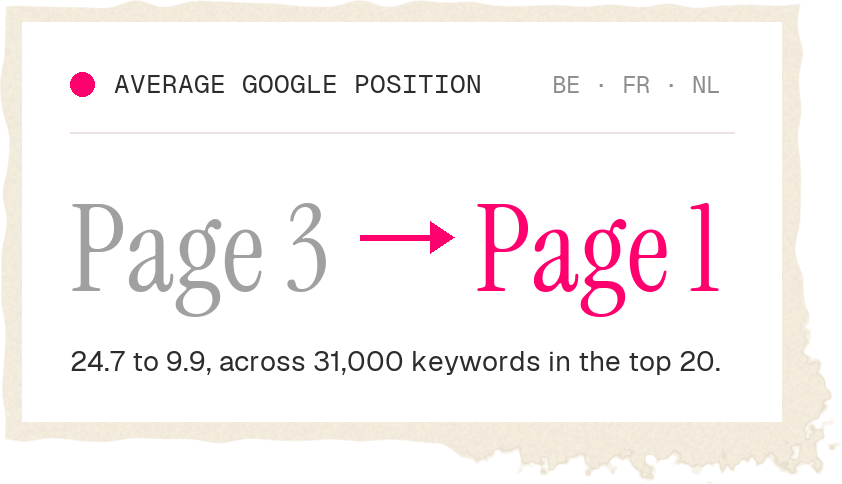
Five pieces of search infrastructure, each holding page-one positions for its anchor query by the end of the engagement - with the French and Dutch sides of the market covered by the same machine.
Positions and impressions: Google Search Console, June 2026, for each cluster’s anchor query; leasing voiture verified at #1 in Belgium in July 2026 (Ahrefs Rank Tracker). Underneath each anchor sits the long tail - the EV clusters alone rank for thousands of related queries between them.